Filter Interface
The filter interface lets you process the signal on-line. This is designed for real-time intergration.
Snippet
#include "spleeter_filter/filter.h"

...

const auto separation_type = spleeter::FourStems;

// Initialize spleeter
spleeter::Initialize(std::string(SPLEETER_MODELS), {separation_type}, err);

// Initialize the on-line filter
spleeter::Filter filter(separation_type);
filter.Init(err);

// initialize a buffer
const auto block_size = 2048;  // defined by the plug-in host
filter.set_block_size(block_size);
rtff::AudioBuffer buffer(block_size, filter.channel_count());

...

// For each block
float* data_ptr = ...
buffer.fromInterleaved(sample_ptr);
filter.ProcessBlock(&buffer);
buffer.toInterleaved(sample_ptr);
Reference
-
void
spleeter::Initialize(const std::string &path_to_models, const std::unordered_set<SeparationType> &separation_types, std::error_code &err) Initialize the spleeter tools by loading models at the specified path
- Parameters
path_to_models: the path to spleeter exported models.separation_types: the types of separation requirederr: an error code that gets set if something goes wrong
-
class
Filter: public AbstractFilter
Tensorflow model
Spleeter is designed to work on raw audio file. The provided neural netwok inputs a stereo signal sampled at 44.1KHz and outputs multiple signals in a similar format.
To run it on-line, we export a cropped version of that network that inputs STFT (Short Time Fourier Transform) frames and outputs Masks (matricies of values in [0, 1] that needs to be multiplies to the STFT to get the output source). To do so, we designed the cmake/export_spleeter_models.py script.
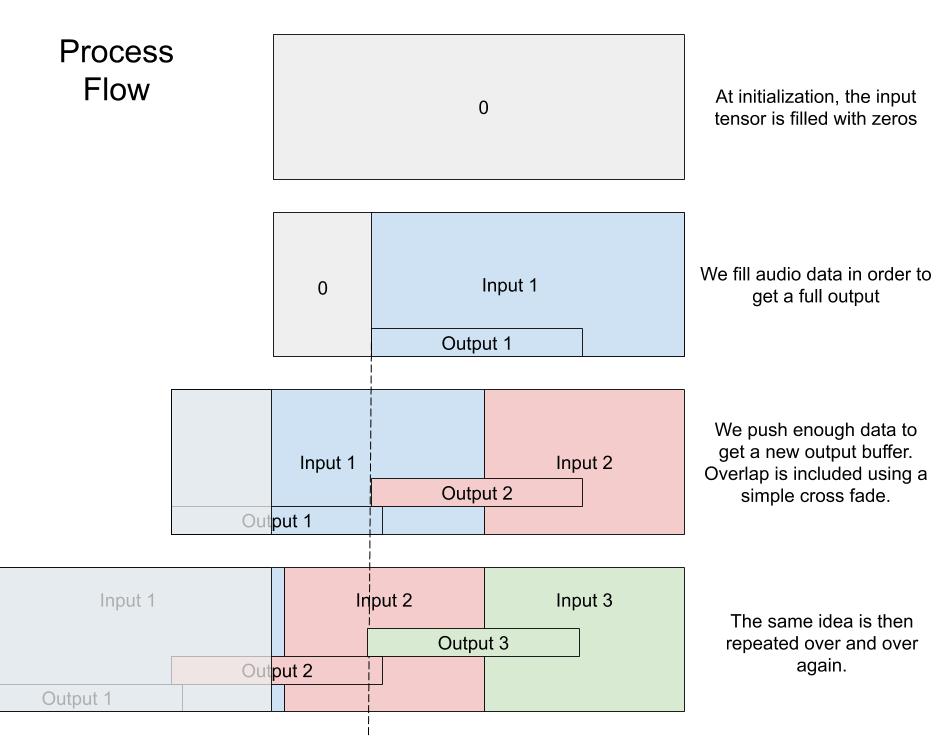
Flow Description
The basic idea is:
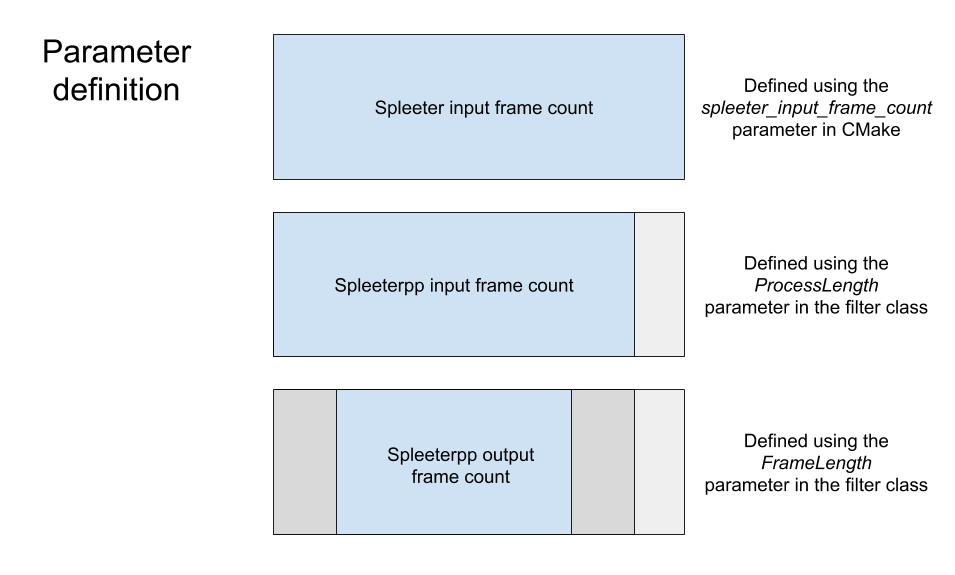
- We run each process on P frames (P <= T)
- We effectively use F frames in each process (F <= P)
- The F frames are centered in the processed buffer. The rest of the processed buffer is filled with past and future data
- We use an overlap of O frames between each process (0 <= O < F). In the overlap, we mean the output
- In Spleeter, the sum of extracted signals may differ from the input. We offer a way to force it using the force conservativity parameter